Reading development over 4 years: eye-tracking from EAP to undergrad
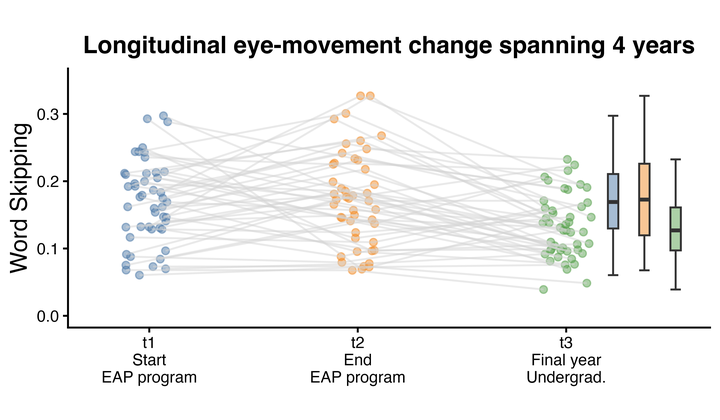 Word skipping across three timepoints (start EAP, end EAP, final-year undergrad).
The big idea
Reading development doesn’t stop when an English bridging program ends. We tracked the same students from the start of EAP (t1) to the end of EAP (t2) and again in the final year of undergrad (t3) to see how reading fluency and reading behavior evolve over time—using eye movements as a real-time window into reading.
What we did
- Followed one cohort across three timepoints spanning ~4 years (t1 start EAP → t2 end EAP → t3 final-year undergrad).
- Measured reading-related skills and eye-movement indicators of reading efficiency (including word skipping, shown in the plot).
What we found
- Change over time was not a straight line: several indicators shifted strongly during EAP, then changed again (often more subtly) during undergrad.
- Crucially, growth during the EAP period still mattered years later: improvements made during the program continued to predict later reading outcomes, even after accounting for where students started.
Why it matters
Programs often evaluate success at the end of instruction. This project shows why it’s worth looking longer-term: (1) reading behavior can continue to evolve after students enter degree study, and (2) the gains students make during bridging programs can have effects that persist into later university study—useful evidence for how universities support multilingual readers beyond the bridging phase.

Daniel Schmidtke
Research Associate
My research interests include psycholinguistics, corpus linguistics and linguistic theory.