Do bridging programs close the reading gap? Eye-tracking evidence from passage reading
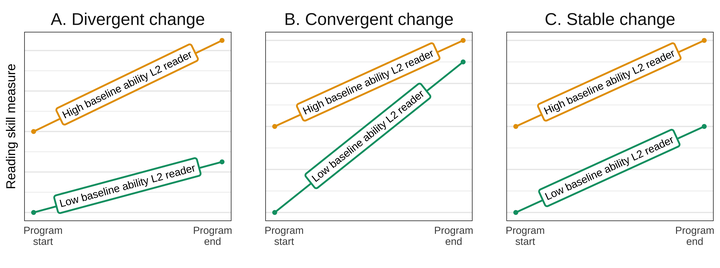 Three possible growth patterns in reading skill during an EAP bridging program: divergent, convergent, or stable change.
The big idea
Bridging programs aim to help students become ready for university-level reading. But an open question is how reading growth unfolds across students who start at different levels. We tested three plausible patterns: the gap could widen (divergent), shrink (convergent), or stay the same (stable change).
What we did
- Collected longitudinal passage-reading data from 405 bridging-program students (Mandarin/Cantonese L1) at two timepoints: program start (t1) and end (t2), across a 28-week program.
- Used eye-tracking while students read full passages for comprehension, plus comprehension questions after each passage.
- Used incoming IELTS Reading scores as an independent measure of baseline reading ability (so we’re not just grouping people by the outcome itself).
What we found
- Students showed overall improvement by the end of the program in reading comprehension and multiple eye-movement indicators of reading efficiency.
- The key result: we found stable change. Students who started stronger stayed stronger, and students who started weaker improved too—but at roughly the same rate (parallel growth trajectories), so the gap didn’t close or widen over the program.
Why it matters
This tells us two things at once: (1) bridging programs can produce meaningful reading gains, and (2) equal slopes don’t automatically mean equal outcomes—students who start behind may need extra, targeted support early if the goal is to narrow the gap by the end of the bridging program.

Daniel Schmidtke
Research Associate
My research interests include psycholinguistics, corpus linguistics and linguistic theory.