Reading experience drives L2 reading speed development
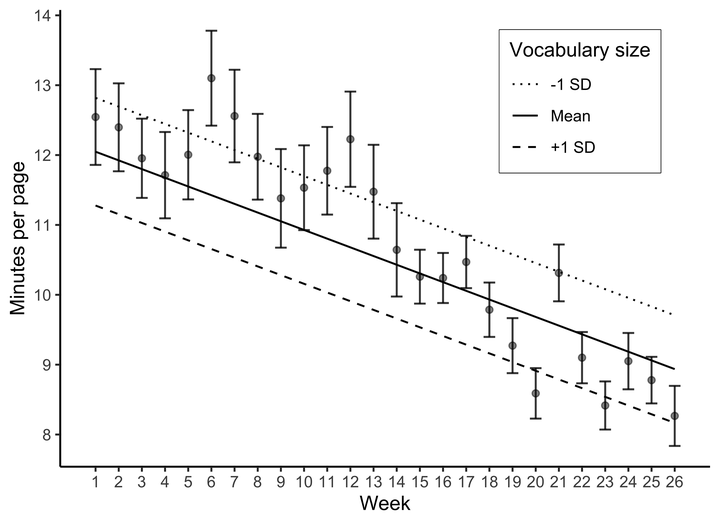 Reading speed improves over the bridging program—and students who read more improve more.
The big idea
Practice matters—but not all practice is equal. We tracked students’ real-world reading habits during a bridging program to test whether reading more English texts gives learners an extra boost in reading speed development, beyond the effect of instruction alone.
What we did
- Followed 142 Mandarin/Cantonese-speaking English learners in an 8-month university bridging program.
- Collected week-by-week reading logs over 26 weeks of classroom instruction, where students recorded what they read, how long they read, and how many pages they covered.
- Modeled change in reading speed over time, then tested whether total pages read predicted who improved the most.
What we found
- Students became faster readers over time: minutes-per-page decreased steadily across the program (a clear linear improvement).
- The key finding: reading experience mattered. Students who read more pages during the program tended to show larger net gains in reading speed.
Why it matters
This gives a simple, practical lever for programs: instruction helps, but encouraging (and supporting) students to read more in English—especially beyond required coursework—can meaningfully accelerate reading fluency growth.

Daniel Schmidtke
Research Associate
My research interests include psycholinguistics, corpus linguistics and linguistic theory.