Reading Gains that Stick: Greater Reading growth during EAP program, Higher GPAs Later
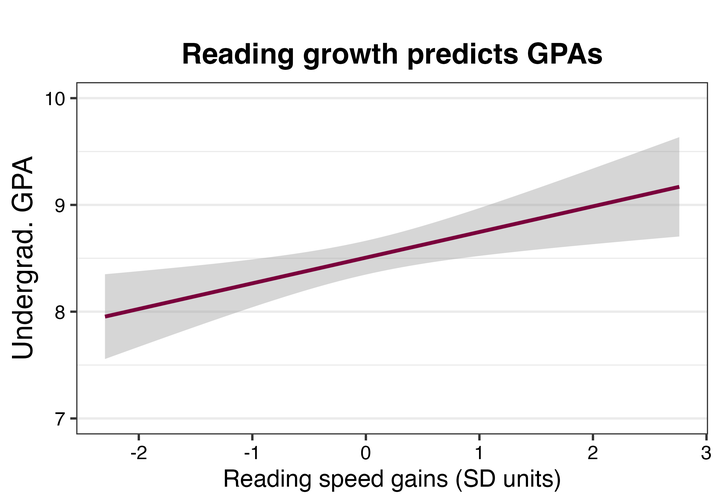 Reading speed change in a university bridging program predicts higher undergraduate GPAs.
The big idea
A lot of research shows that students improve during English bridging programs — but much less is known about whether those improvements pay off once students are in their degree programs. We linked students’ pre-university reading growth to their GPAs up to four years later.
What we did
- Followed 405 English-as-an-additional-language (EAL) students through a 28-week university EAP program.
- Measured reading and reading-related skills at the start and end of the program (including silent reading rate).
- Predicted later undergraduate GPA using a mix of modern and traditional statistics:
- Random Forests to discover which variables mattered most
- Regression to quantify the size of the effect
What we found
- Among many predictors, reading-rate growth during the program emerged as one of the top predictors of future GPA (a rare case where a change score is doing real work).
- The relationship was meaningful in practical terms: a ~26 WPM larger improvement in silent reading rate predicted about a 0.21 GPA increase.
- In plain language: students who became more efficient readers before university tended to thrive more academically afterward.
Why it matters
Reading isn’t just “one skill among many” at university — it’s the gateway to lectures, slides, textbooks, assignments, and exams. Our results suggest that helping students speed up comprehension-focused reading before degree programs begin can have long-lasting academic benefits.

Daniel Schmidtke
Research Associate
My research interests include psycholinguistics, corpus linguistics and linguistic theory.