How “In-Group Positivity” Spreads: Language, Bias, and Cultural Transmission
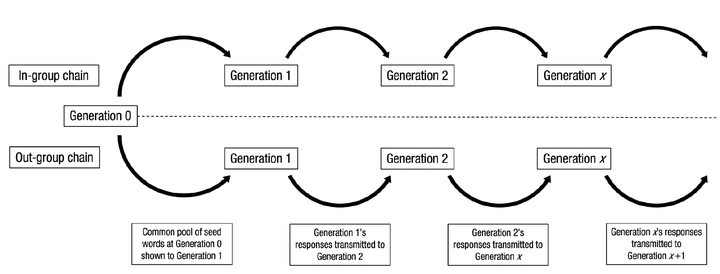 How positivity about “us” spreads faster than negativity about “them.”
The big idea
Intergroup bias isn’t only what people think—it’s also what people say. We tested whether language becomes more positive when people describe an in-group (“us”) than an out-group (“them”), and whether those tiny language shifts can accumulate as they get passed from person to person.
What we did
- Ran two online experiments to compare the positivity of words used to describe in-groups vs. out-groups, across a wide range of “seed” descriptions (from negative to positive).
- Scored word positivity using a large independent database of valence ratings (instead of researchers hand-coding words as “positive/negative”).
- Used a linear diffusion chain (iterated learning) design to test whether bias amplifies across generations as each new group inherits the previous group’s output as their input.
What we found
- People reliably used more positive language for the in-group than the out-group (in-group favoritism).
- The positivity boost for the in-group was strongest when the starting information was negative—people “rescued” the in-group from negative descriptions more than they attacked the out-group.
- In the diffusion chains, in-group positivity tended to grow across generations, and it propagated faster than out-group derogation.
Why it matters
A small bias in word choice can become a big deal when it spreads socially. This study suggests that language doesn’t just reflect bias—it can also help transmit and amplify it over time, especially via “warm glow” toward the in-group rather than outright hostility toward the out-group.

Daniel Schmidtke
Research Associate
My research interests include psycholinguistics, corpus linguistics and linguistic theory.